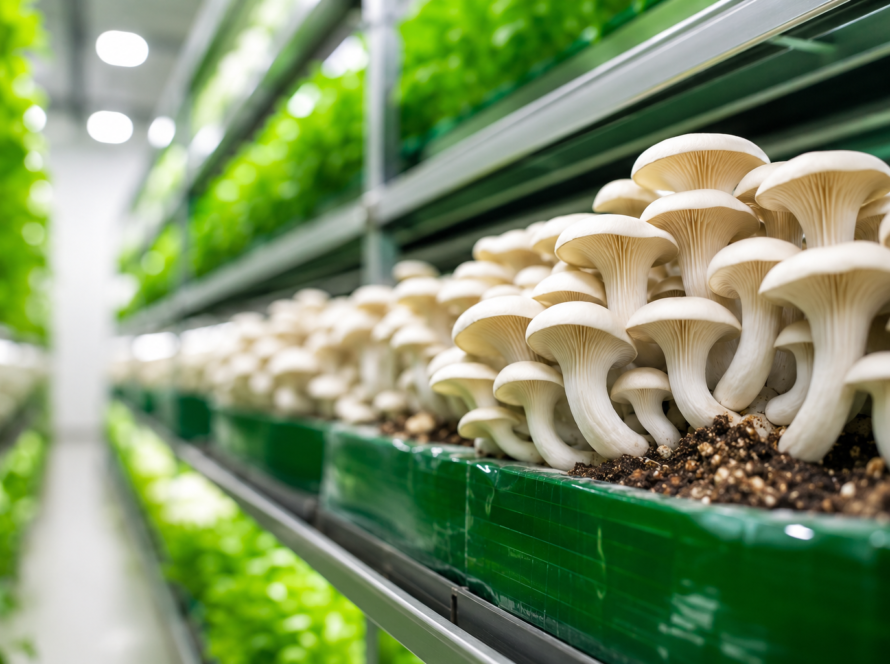
Button mushroom farming is the process of growing white button mushrooms (Agaricus bisporus) under carefully managed conditions using prepared compost, mushroom spawn, casing material, and suitable temperature and humidity. In India, it can be practised seasonally in suitable climates or in controlled growing rooms where environmental conditions can be managed throughout the year.
Button mushrooms are widely used in homes, restaurants, hotels, and food-processing businesses. However, successful cultivation requires more than a growing room: compost quality, hygiene, climate management, and market planning all play important roles. This guide explains the button mushroom farming process step by step, helping beginners understand the major stages before starting cultivation.
What Is Button Mushroom Farming?
Button mushroom production is a process whereby the edible mushrooms known as Agaricus bisporus are cultivated in a compost substrate. In contrast to most of the oyster mushroom cultivation processes, the button mushroom cultivation needs a casing on the colonized compost for proper development.
The whole process consists of stages such as compost production, pasteurization and conditioning, inoculation, spawn running, casing, fruiting, harvest and clean up of the growing chamber.
For the Indian market, selection of the two types of cultivation methods depends on climate and other factors.
Step-by-Step Button Mushroom Farming Process
Step 1: Select a Suitable Location and Growing System
Choose a location which has clean water, electricity (as needed), transportation, labor, and potential buyers of the product.
These are the two types of farming:
- Seasonal farming: Suitable where the climate allows the crop to grow throughout the season without the need for any artificial cooling of the environment.
- Controlled environment farming: Involves the use of artificially created farming rooms and environmental controlling equipment.
The button mushrooms farming in the northern part of India has always been associated with the cold seasons. Even though it may be possible to use controlled farming rooms, it will be essential to factor in the expenses and technicalities.
It is important to understand the local consumer’s requirements and distribution methods before choosing a farming system.
Step 2: Prepare or Source Quality Mushroom Compost
The main substrate for cultivation of button mushrooms is compost. All needed nutrients are contained in compost to support their proper growth and development.
In industrial production, the preparation of compost involves the choice of proper raw materials, watering, decomposition and the right pasteurizing process. It’s possible to use straw substrates and other proper materials according to some known production technology.
For beginners, it may be simpler to buy the compost for spawning from some reliable producer rather than produce it on your own. Remember to ask questions regarding the composting process, quality of the product, its readiness for spawning and correct handling.
Improper processing of the compost will cause uneven growth and development of the mushrooms and their contamination. Don’t trust the readiness of the compost only because it is black in color and has the soil-like structure.
Step 3: Obtain Reliable Mushroom Spawn
Spawn refers to the planting material that contains mycelium of the mushrooms. The spawn used for growing button mushrooms should be specifically designed for Agaricus bisporus.
Before buying the spawn, one should ensure the following:
- Reputation of the supplier and identification of the product
- Details about the batch and storage instructions
- Suitability of the spawn for the planned cultivation process
- Transportation and usage instructions provided by the supplier
The storage and handling of spawn should follow the supplier’s recommendations. The contaminated, damaged, and improperly stored spawn may negatively affect the crop.
The correct spawning rate will depend on the cultivation method, condition of the compost, and spawn.
Step 4: Mix the Spawn into Prepared Compost
This step is known as spawning. The spawn is spread over appropriate compost in such a way that the mycelium of the mushrooms grows in the entire material.
Spawning should be carried out in a clean work area. It should be done using sanitized tools and should not involve any unnecessary handling of the material which may result in contamination.
The compost should then be placed in the growing containers or beds as per the farm’s system. Batch records should be maintained showing the source of the compost, the spawn batch, the date of spawning, and the growing room assigned.
Step 5: Manage the Spawn-Running Stage
During spawn running, the mycelium penetrates through the compost. This is crucial since the growing mycelium prepares the compost for the next phase of cultivation.
The atmosphere within the room should be closely watched. The compost temperature differs from the air in the room as biological activity generates heat. Thus, taking the air reading alone may not give a full view of the crop situation.
Temperature and humidity requirements for button mushrooms at each particular stage are provided by ICAR-DMR. The actual values depend on the strain used, the compost system, and the measurement place.
During this stage:
- Monitor compost and room conditions consistently.
- Keep the growing area clean.
- Avoid sudden, unnecessary changes to environmental settings.
- Check for unusual odours, discolouration, or visible contamination.
- Record observations and investigate irregular growth before proceeding.
Do not move to casing solely because a fixed number of days has passed. Confirm that the compost and mycelium are ready according to the cultivation protocol being followed.
Step 6: Apply the Casing Layer
Casing is an essential process in mushroom growing. This is the process where the appropriate casing layer is applied to the compost after the colonization of the compost by the mycelium.
The casing helps in retention of moisture, formation of mushrooms, and creation of environmental conditions necessary for fruiting. The use of casing does not mean replacing the compost which serves as the nutrient medium of the crop.
Use the right casing material which should have the right physical characteristics and be adequately treated to prevent problems of contamination. Ensure that the application of the material has been done to the correct depth and moisture levels based on the system of production you are using.
After casing, create an environment where there will be mycelium growth through the casing layer without drying or soaking the casing.
For further technical information, refer to the button mushroom casing guide.
Step 7: Manage Temperature, Humidity, and Ventilation
Environmental management assumes particular significance as the crop approaches pinning and fruiting.
Key aspects that need to be monitored include:
- Temperature: The requirements vary depending on the stage whether spawn running, casing, pinning, or fruiting.
- Relative humidity: Assists in controlling the moisture loss, but high relative humidity does not mean that the crop is healthy.
- Ventilation and carbon dioxide: The fresh air management affects the growth environment and mushrooms.
- Water management: The moisture in the casing needs to be checked prior to watering as too much moisture can cause problems.
- Air circulation: The conditions must be fairly uniform for the growing racks and the different positions in the rooms.
Do not use the same temperature and humidity levels for all stages. In the case of ICAR-DMR button mushroom production, there is a difference between the environmental requirements for the colonization phase and the fruiting phase.
Use appropriate measuring devices, keep track of the records and make changes based on the stage and production system used. If growth is uneven, find out the reasons for it.
Step 8: Observe Pin Formation and Mushroom Development
After the casing and the environmental factors are set, the little buds of mushrooms called pins start forming. These mushrooms will grow to maturity under favorable conditions.
Keep monitoring the growing beds at all times. Check if there are inconsistencies in the development of the pins, any unusual marks, drying, waterlogging, pests, and diseases.
If there are any inconsistencies in the development of the pins, it is an indicator of success. However, in case of inconsistencies in the development of the pins, it means that there could be more than one cause of the problem. It could be caused by the compost, casing, watering, conditions of the room, and contamination.
Make sure that the environment is clean and that proper equipment is being used. If there are any unusual signs, seek advice from experts in mushroom cultivation.
Step 9: Harvest Button Mushrooms at the Right Stage
Harvest button mushrooms considering the quality standards expected by the consumer and the proper maturity level at which the particular mushroom cultivars have to be harvested.
In case of fresh market consumption, factors such as the appearance, firmness, cleanness, and handling techniques may affect the marketing process. Early harvesting causes low-size buttons; delayed harvesting may influence the appearance and shelf-life of the mushrooms.
During harvesting:
- Use clean hands or suitable sanitised harvesting tools.
- Handle mushrooms gently to minimise bruising and damage.
- Remove adhering casing material carefully.
- Separate damaged or diseased mushrooms from saleable produce.
- Transfer harvested mushrooms promptly to suitable post-harvest handling conditions.
Mushrooms might be produced through several flushes depending on how the crop was grown.
Step 10: Clean the Growing Room and Review the Crop
Once the crop is done, take out old compost and crop waste and use an approved method of cleaning and sanitizing before moving on to the next one.
It should not be assumed that the room is ready for reuse just because there is no visible waste anymore. It should be cleaned properly by the farm’s standards of hygiene.
Examine the crop data in order to evaluate:
- Quality of compost and spawn
- Timing of the crop and environmental conditions
- Contamination or pests
- Amount of sellable harvest and rejected produce
- Costs of labor, energy, packaging, and transportation
- Buyer comments and sales prices
This will help in finding ways to improve in the future and make farm planning more realistic.
Equipment Required for Button Mushroom Farming
It will depend on the size of the farm and whether you are making the compost yourself or buying it already prepared.
Some of the common needs could be:
- Growing trays/beds/racks
- Temperature and humidity measuring instruments
- Ventilation and air management system
- Cooling/Heating system, if necessary
- Irrigation system
- Sanitization and cleaning equipment
- Harvesting equipment, harvesting boxes, and other post-harvest facilities
If you are using controlled environment facilities, there could be some other needs for electricity, climate control, and monitoring systems. These should be evaluated before purchasing any equipment. You could also refer to the Desi Fasal guide to mushroom farming equipment.
Common Mistakes to Avoid in Button Mushroom Farming
Beginners can reduce avoidable crop problems by paying attention to the following areas:
- Use of improper compost: Make sure the compost is ready for use before spawning.
- Acquisition of unreliable spawn: Locate a good source of spawn and adhere to its storage guidelines.
- Absence of casing preparation: Use appropriate casing materials and casing treatment techniques.
- Use of the same climatic conditions throughout the process: Vary conditions based on the crop’s growth.
- Over or under watering: Make sure that there is enough moisture in the casing and adhere to the stage-by-stage watering guidelines.
- Absence of cleanliness: Clean all the equipment and places of growth properly.
- Starting production without performing market research: Determine the buyers, quality standards, packaging, and delivery options.
The growing of button mushrooms requires the integration of efforts on the part of the growing medium, climatic conditions, hygiene, and harvesting process. The process-oriented approach is more important than making assumptions and applying someone else’s settings without considering their conditions.
Is Button Mushroom Farming Suitable for Beginners in India?
Of course, people new to cultivation can be taught how to cultivate button mushrooms, but it must be remembered that mushroom cultivation has different composting, casing, and climate requirements.
To begin with a smaller unit and proper planning or by taking up a course can help beginner farmers understand the entire procedure before going for a larger unit. If possible, it may be advisable to visit a mushroom farm and get help from agricultural colleges, mushroom growers, and extension agencies.
For those intending to set up a mushroom farm commercially, it would be advisable to do a requirement analysis concerning the market, availability of good quality compost and spawns, infrastructure, manpower, energy requirements, and costs involved.
Conclusion
Mushroom cultivation in India is a series of interconnected stages that include composting, spawning, casing, environment management, harvesting, and room sanitation. Each stage influences the next one, which means that the quality of the inputs used and proper hygiene practices are vital for successful production.
Prior to cultivation, the climate of the region should be analyzed, a proper cultivation system selected, the availability of the necessary inputs should be confirmed, and possible customers should be found. With proper training and a proper production plan, newcomers can develop a better understanding of button mushroom cultivation and take more effective steps towards expanding their business.
For further information about mushroom farming and equipment for mushroom farming, refer to Desi Fasal website.
Frequently Asked Questions (FAQs)
1. What is button mushroom farming?
Button mushroom farming involves growing Agaricus bisporus in specially prepared compost with spawn, casing layer and controlled conditions. This farming can be done either seasonally or through controlled growing facilities.
2. What are the main steps in button mushroom cultivation?
Main steps include selection of suitable growing system, preparation or procurement of compost, procurement of good quality spawn, spawning, spawn running, casing, pinning and fruiting management, harvesting and cleaning of growing rooms.
3. Can button mushrooms be produced all the year round in India?
They can be produced seasonally or during off seasons in appropriate climatic conditions in suitably designed controlled environment facilities. Continuous production will depend on infrastructure, technical management and operational costs.
4. Why is casing important in button mushroom farming?
It is a layer of appropriate substance placed over colonized compost. It ensures moisture retention, development of mushrooms and provision of environment for fruiting.
5. What should beginners consider before embarking on button mushroom farming?
Beginners should consider the local market demand, availability of compost and spawn, climatic conditions, growing room facility, hygiene, labour, utility and post harvest management. They can use training and cost analysis to choose a suitable production